




Full-stack developer in Greater Noida. I build software and then keep it running: a Discord bot with 72k+ users, an offline-first memory for field crews, and the productivity app I open every morning. Founder and lead developer of Annie, Discord community manager at Geek Room, and a CSE first-year at JIMS Greater Noida (GGSIPU). Everything below is in production, and I'm the one who keeps it there.

Now: running Annie with a small team, and managing Geek Room's 3,000-member Discord and the bot that runs it.
| Annie | Discord bot that replaces six single-purpose bots. 417 commands, sharded, with a Next.js dashboard. | annie.monster |
| GeekRoom bot | Runs Geek Room's 3,000-member Discord: case-tracked moderation, escalating automod, contest reminders, a daily problem. Python, with a Next.js dashboard. | geekroom.dpdns.org |
| DailyOS | Personal productivity OS. Eleven modules over one Prisma schema. | live · source |
| FieldMind | Offline-first memory for field technicians on Qdrant Edge. Team build. | source |
| FieldProof | Field photos in, verified and report-ready evidence out, for NGOs. Top 25 of ~400 at Code Cubicle 6.0. Team build. | demo · source |
| The Silent Co-Driver | Scores driver stress from F1 team radio. 3rd place, AI Race Month. Team build. | source · slides |
| Café de' Mercanti | UI and UX concept for an Old Montreal café. Hand-built in HTML, CSS and JS. | live · source |
Annie · annie.monster

Closed source; I founded it and lead the small team that builds it. An all-in-one Discord bot that replaces the six single-purpose bots most servers end up running — economy, moderation, music, games, social, community tools.
417 commands (313 prefix + 104 slash) across 23 categories · 29 event
listeners · ~125k lines · sharded through discord.js ShardingManager ·
anti-nuke and automod · a simulated coin market with generated charts.
The dashboard is a separate Next.js app — ~41k lines, 128 API routes — with Discord OAuth2, per-guild config panels so nobody has to memorise command syntax, premium checkout with IPN callbacks, a public status page with incident history, and rendered ticket transcripts.
The bug I'm most proud of fixing
Shards leaked memory on a 2-core container: RSS climbed steadily while the JS heap stayed flat. It wasn't JavaScript.
glibc's mmap threshold is dynamic — it ratchets upward every time a large
buffer is freed. So after the first few canvas/sharp image buffers came and went,
subsequent large allocations started coming from the arena heap (sbrk) instead
of mmap, and arena memory is never returned to the OS.
Pinning MALLOC_MMAP_THRESHOLD_ to a fixed 128KB disables the ratchet — every
large allocation uses mmap, which is returned on free. MALLOC_ARENA_MAX=2
stops the container (which reports 16 cores but is limited to 2) from opening
~128 malloc arenas that fragment and never hand memory back.
Both have to be set in code before manager.spawn(), not in .env — glibc and
libuv read them at process start, before dotenv ever runs.
DailyOS · dailyos.dpdns.org · source

A personal productivity OS — notes with folders, tasks, projects, calendar, habits, goals, analytics, study mode, focus timer, doodle canvas, and a developer mode. Eleven modules over 34 Prisma models in one schema, so a task can come from a note and a habit can roll into a goal without an integration in between.
Notes carry three editing modes on one record: rich text, a sketch pad, and a freeform canvas you double-click to drop text onto. File bytes live in MongoDB GridFS rather than Postgres, so a large PDF isn't sitting in a row that gets read on every page load.
Next.js 16, Prisma, Neon, Auth.js v5. Vercel behind Cloudflare.
The bug I'm most proud of fixing
Uploading a profile picture signed you out, and everything afterwards crawled. The two symptoms looked unrelated and had one cause.
An uploaded avatar was stored as a data URL — up to two megabytes — and handed
to updateSession, which put it on the session token. That token is serialised
into a cookie, and a cookie holds about four kilobytes. Auth.js does not fail on
that; it splits the token across numbered chunks — authjs.session-token.0,
.1, .2 — so every subsequent request carried megabytes of cookie. That was
the slowness.
The sign-out was the proxy: it looked for the session cookie by exact name, so the moment the token was chunked there was no cookie by that name, and a signed-in user looked signed out.
Matching the chunk prefix fixes the symptom. The actual fix was keeping the bytes out of the token at all — the jwt callback reads the avatar from the database and puts a URL on the token, and the image is served from a route. No future caller can reintroduce it by passing an image either.
FieldMind · source
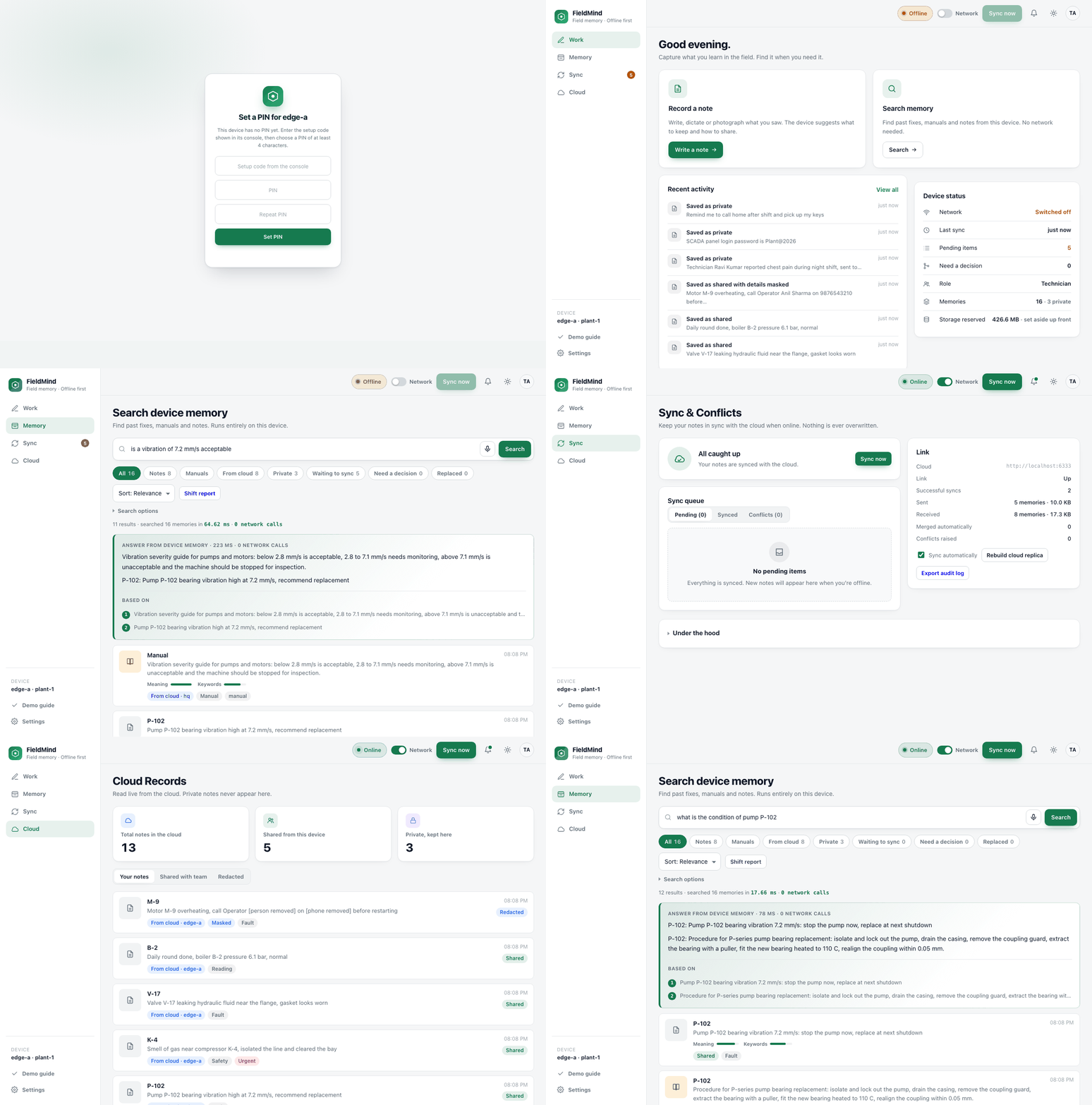
Built on Qdrant Edge with Team Compilers. A technician records what they see and do. The device remembers it, searches it in about a millisecond with no network, answers questions from it with citations, decides by itself what is safe to share, and syncs with the fleet through Qdrant Server whenever a link exists.
Two Qdrant Edge shards inside the app process, a third for photos; dense vectors
from bge-small on CPU plus built-in BM25. A policy engine classifies every note
in about 20 ms — pattern detectors, a quantised BERT name model and a semantic
classifier — and learns from the technician's overrides without ever keeping the
text. Every change goes to a durable outbox first; uploads are compare-and-swap
writes; a device that is far behind restores from a shard snapshot instead of
pulling a diff. Concurrent edits merge field by field, true clashes wait for a
person, and nothing is overwritten.
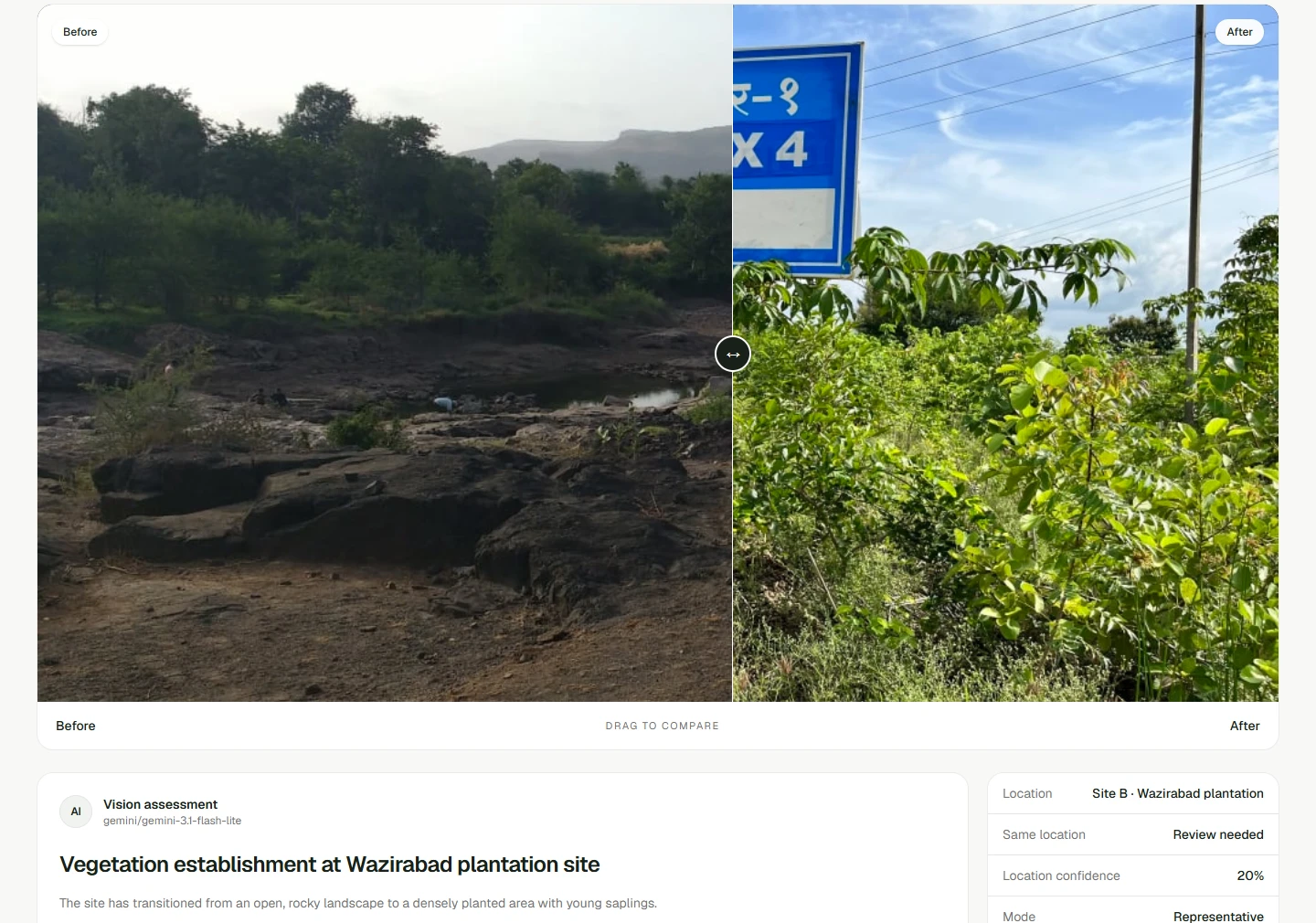
Code Cubicle 6.0, top 25 of ~400 teams. An NGO restoring a riverbank takes thousands of photos over six months; a donor asks what changed. FieldProof sorts every photo into site and phase from GPS and EXIF, flags near-duplicates and impossible dates, turns a before/after pair into a plain-language assessment from a vision model that first has to agree the two photos show the same spot, searches by meaning, and writes a donor-ready report in which every image traces back to its original.
Next.js 16, TypeScript strict, Cloudinary for the media pipeline, Postgres with pgvector for search, Gemini for captions and assessments.
3rd place, AI Race Month · GrandPrix — two-person team, built in a day.

A pit wall watches tyre temps, fuel and sector deltas. Nobody has time to process the one channel that carries fatigue first: the driver's own voice. This reads Formula 1 team radio, scores how stressed the driver sounds 0-100, and lines that score up against his real lap times.
Three Hugging Face models chained — faster-whisper large-v3 for transcription with per-word timestamps, HuBERT for emotion from the sound, DistilRoBERTa for emotion from the words — blended 65/35 in favour of tone, because a driver saying "I'm fine" through gritted teeth is not fine. Vocal energy separates the two ways of not being okay: stress is loud, fatigue is flat. Thresholds are the 90th percentile measured across 63 real clips, not numbers that felt right.
278 laps · 72 radio calls · 4 drivers, one Grand Prix. Radio from a Hugging
Face dataset, lap times from the F1 timing feed via fastf1, joined only on a
timestamp. FastAPI backend, no framework on the frontend, and every model runs
locally so it works with the wifi off.
The bug I'm most proud of fixing
The transcripts looked fine. But on one clip the loudest part of the waveform had no words against it.
Whisper was silently dropping whichever speaker talked first. On real team radio the driver asks and the engineer answers — so we were keeping the engineer's calm reply and throwing away the driver's question. On a project that exists to read the driver's voice, every score was measuring the wrong person, and nothing errored.
vad_filter=True fixed it: voice-activity detection segments the audio before
transcription instead of letting the decoder decide what counts as speech. The
trade-off is that VAD trims some word starts, so a few transcripts came back
slightly worse — a garbled phrase is a much smaller failure than a missing
speaker, so we kept it and filtered the garbled ones out of the demo.
The join has a similar story. Lap boundaries were first derived by assuming the
race started at 17:10:00 UTC. Lights-out was 17:13:00, so all 34 radio calls sat
two to three laps early — and the chart still looked entirely plausible. Only
loading the session telemetry and using the real LapStartDate fixed it.
Portfolio · yabhinav.is-a.dev · source
Server-rendered Node with an /admin panel, libSQL on Turso, no build step and
no frontend framework. Live counters from Annie, a GitHub contribution heatmap,
a content-security policy that allows only its own two hashed scripts, and the
badge at the top of this page.

A UI and UX exercise, not a client site: a one-page website for an Italian espresso bar in Old Montreal, in plain HTML, CSS and JavaScript. A menu slider with tabs, dots and swipe, opening hours that highlight today, specials, a gallery, and scroll reveals. Bodoni Moda and Inter on a coffee palette with a copper accent.
| Frontend | Next.js · React · TypeScript · Tailwind · Framer Motion · Chart.js |
| Backend | Node · Express · Python · FastAPI · MongoDB · Postgres · SQLite / Turso · discord.js |
| AI & search | Hugging Face · Whisper · ONNX · Qdrant · pgvector · Gemini · Cloudinary |
| Infra | AWS · Oracle Cloud · Vultr · Vercel · Fly.io · Cloudflare · Docker · Linux |

Working on something hard? yabhinav0011@gmail.com